Thursday, November 8, 2012
Thursday
Here is today's markup of Langston Hughes' "Mother to Son." Your homework is to determine which twenty poems you would like to study. Keep a thought on the calendar.

Monday, October 29, 2012
Grades
A-day grades are not complete on the report cards. The district office declared that grades should be due at 11 am on the work day rather than at the end of the work day. I will supply you with a printout in the morning if you wish, but about half of you will have an incomplete until I enter a grade change, which I will do as soon as the office says I can. This incomplete will be printed on the report card, but of course the changed grade will be the transcript grade.
Late papers or papers without all the requisite parts (prior drafts and my printed feedback) also ended as incompletes for the quarter. Incompletes for these students are appropriate until I get to them or until they get the missing pieces in place.
JKoon
Friday, October 12, 2012
Friday
For your presentations next week, be sure you meet the rubric criteria!
Here is a good web site instructing you how to compose and structure body paragraphs in literary analysis -- you know, like commentary papers.
Here is a simple guide for constructing paragraphs in literary analysis. The "comment" part can be many sentences long:
1. Topic containing critical concept
2. Transition and set up: provides context for quote.
3. Quote from book punctuated correctly, or a very clear, direct reference to the literary work
4. Explanation and comment: what does your quote prove about your topic?
5. Wrap: last sentence says something worthwhile AND contains a key word from the topic sentence AND transitions forward.
Here is a good web site instructing you how to compose and structure body paragraphs in literary analysis -- you know, like commentary papers.
Here is a simple guide for constructing paragraphs in literary analysis. The "comment" part can be many sentences long:
1. Topic containing critical concept
2. Transition and set up: provides context for quote.
3. Quote from book punctuated correctly, or a very clear, direct reference to the literary work
4. Explanation and comment: what does your quote prove about your topic?
5. Wrap: last sentence says something worthwhile AND contains a key word from the topic sentence AND transitions forward.
Wednesday, October 10, 2012
Wednesday
Hope you're having a good day job shadowing (wink). See the post to the right: examine the rubric and see if you can pinpoint problelms or make suggestions on it. (The two-person and four-person rubrics are combined into one .pdf document).Otherwise, use it to structure your presentations. You might need Flash or a computer to see the embedded file. Or you can use the link right here.
Note that there is an element set aside for professional attire.
Note that there is an element set aside for professional attire.
Friday, October 5, 2012
Friday -- about due dates and requirements
1. On Monday for A-day, and on Tuesday for B-day, revise your commentary drafts. Your papers are due regardless of other activities such as history tests. Bring me your papers on the due date. Late papers will be docked 20 points, and I do not guarantee in-depth feedback for them. After the due date for the final, the second draft will not receive credit at all.
2. Bring in the entire packet: your first draft, the feedback you received from another student, and the second draft. Put the first draft on the bottom, the feedback in the middle, and the second draft on top. Staple all of it together. Failure to follow this instruction means you have NOT turned in your drafts on time. Failure to staple them together in order, but with all elements present, will result in a 10-point dock for not following the assignment instructions. Why would anyone not do this as instructed?
3. Format your paper according to MLA style. I have a sample paper on the blog. It is a commentary on Arna Bontemps’ “Southern Mansion.” Better yet, you can look up “mla style” and choose “The OWL at Purdue” for a great resource on writing. There is an MLA section that gives examples and explanations, though formatting does not really require a lot of expertise. Just do it as it says. Failure to format according to MLA style, including the use of 12-point, Times New Roman font and double spacing, will result in a 10-point dock of your second draft grade. Express your individuality in the content and thought, not in your font selection.
4. On my end, I will do my best to give you in-depth, personal feedback on each of your papers in a very timely fashion with plenty of time for revision before the final due date of October 22/23.
2. Bring in the entire packet: your first draft, the feedback you received from another student, and the second draft. Put the first draft on the bottom, the feedback in the middle, and the second draft on top. Staple all of it together. Failure to follow this instruction means you have NOT turned in your drafts on time. Failure to staple them together in order, but with all elements present, will result in a 10-point dock for not following the assignment instructions. Why would anyone not do this as instructed?
3. Format your paper according to MLA style. I have a sample paper on the blog. It is a commentary on Arna Bontemps’ “Southern Mansion.” Better yet, you can look up “mla style” and choose “The OWL at Purdue” for a great resource on writing. There is an MLA section that gives examples and explanations, though formatting does not really require a lot of expertise. Just do it as it says. Failure to format according to MLA style, including the use of 12-point, Times New Roman font and double spacing, will result in a 10-point dock of your second draft grade. Express your individuality in the content and thought, not in your font selection.
4. On my end, I will do my best to give you in-depth, personal feedback on each of your papers in a very timely fashion with plenty of time for revision before the final due date of October 22/23.
Wednesday, October 3, 2012
Wednesday
For a grade: all students should have their commentary files with them or easily accessible on the web (email, web lockers, Google docs, Dropbox) so that they can work productively during class.
Wednesday, September 26, 2012
Wednesday
Somebody -- let's call him X for short -- has book #39...
Three of you have still not claimed any text for your commentary.
Here is my suggestion for your introduction:
The beginning should contain the title, the author, the genre, and general comments about setting and subject. It should contain the specific context of the passage you choose: This passage comes from a middle scene when Boy Willie brings a girl home from a night out and Berniece sends her out. It should contain the significance of the scene you have chosen: The extract serves to introduce the need the characters have for love and physical comfort and contrasts Boy Willie’s lively desires with Berniece’s rule-bound, self-restricted behavior. Finally, it should introduce the principles of division you intend to employ: First, this passage employs disruptive sound effects and actions in the stage directions to intrude on the peace of the house. Second, the language of Boy Willie contrasts with the language of Berniece, emphasizing the difference in their views of their own selves and their culture. Finally, the stage’s physical arrangement provides further information about Boy Willie, Berniece, and their relationships to each other and their history.
Three of you have still not claimed any text for your commentary.
Here is my suggestion for your introduction:
The beginning should contain the title, the author, the genre, and general comments about setting and subject. It should contain the specific context of the passage you choose: This passage comes from a middle scene when Boy Willie brings a girl home from a night out and Berniece sends her out. It should contain the significance of the scene you have chosen: The extract serves to introduce the need the characters have for love and physical comfort and contrasts Boy Willie’s lively desires with Berniece’s rule-bound, self-restricted behavior. Finally, it should introduce the principles of division you intend to employ: First, this passage employs disruptive sound effects and actions in the stage directions to intrude on the peace of the house. Second, the language of Boy Willie contrasts with the language of Berniece, emphasizing the difference in their views of their own selves and their culture. Finally, the stage’s physical arrangement provides further information about Boy Willie, Berniece, and their relationships to each other and their history.
Tuesday, September 25, 2012
Tuesday
Hardly anyone from A-day has chosen a passage for commentary. If you simply show up on Friday with a passage, do NOT expect credit. Your parts must be run through an approval process to be sure there are not endless repetitions. Part of the reason for this assignment is to teach each other about various sections of the play. Not everyone can have the first page.
Wednesday, September 19, 2012
Friday, September 14, 2012
First deadline
First draft of written commentary is due on Thursday 27/Friday 28. Pick your passages and some backups.
Tuesday, September 11, 2012
Thursday/Friday
Preliminary notice of quarter assignments:
A. Choose 30-60 lines on which to do a written commentary of 4-6 pages in length (MLA format, Times New Roman 12 point font). No more than two people may do a single extract.
AND
B. Choose one of the following (or devise one of your own) to present in teams of two or four (four people per team simply means you prepare both sides with two "lawyers" per team):
1. Make a case for or against
Boy Willie's rights to the piano
Berniece's rights to the piano
Present with an opposing team in the form of a trial
- Introductory arguments (generalities that you intend to prove)
- Presentation of evidence
- Visual aid to enhance arguments (not to replace or substitute for them)
- Cross examination of the opposing team
- Closing arguments
2. Make a case for or against
The piano as blessing
The piano as curse (you may change the dichotomy if you like)
Follow form of trial as above.
3. With a partner, present an argument detailing the roles of dreams, visions, and mysterious monologues in the play. You must present with a visual aid that enhances your argument but does not replace or substitute for it. You must build a case for a purposeful role.
4. With a partner or not, present an argument detailing the role of songs in the play. You must use a visual or audio-visual aid. You must build a case for a purposeful role.
5. With a partner or not, present an argument detailing Berniece's role in the play with regard to her various relationships. You must use a visual or audio-visual aid.You must build a case for a purposeful role.
6. Develop a case on a topic of your own device. You must use a visual or audio-visual aid. You must build a case for a purposeful role. (ghosts, trains, money, burdens, or others).
Presentation of trials should last for 20-30 minutes. Presentations of roles should last for 10-15 minutes.
If you have wishes or desires to contribute to the rubrics and timelines, think of them for next class (Thursday/Friday). You may also choose parts and teams on those days. These will be the major grades of the nine weeks.
Tuesday, September 4, 2012
for Thursday/Friday
Revise this passage, an exchange between Lymon and Avery, into correct Standard English. After doing so, think about the difference the change in language would make in the scene.
LYMON: How you know the rope ain’t gonna break? Ain’t you scared the rope’s gonna break?
AVERY: That’s steel. They got steel cables hold it up. It take a whole lot of breaking to break that steel. Naw, I ain’t worried about nothing like that. It ain’t nothing but a little old elevator. Now, I wouldn’t get in none of them airplanes. You couldn’t pay me to do nothing like that.
Here are the classwork guiding questions for note-taking:
Act I, Scene 1 (continued)
3. Classify the characters who have appeared so far with a brief description and some evidence of their character cited from the text. (Boy Willie, Lymon, Doaker, Berniece, Maretha, Avery, Wining Boy)
4. What or who are the "Ghosts of the Yellow Dog"?
5. Compare and contrast Boy Willie's attitude toward the piano with Berniece's.
6. How does the allusion at the end of the scene influence your evaluation of Boy Willie's attitude toward the piano?
Here are the classwork guiding questions for note-taking:
Act I, Scene 1 (continued)
3. Classify the characters who have appeared so far with a brief description and some evidence of their character cited from the text. (Boy Willie, Lymon, Doaker, Berniece, Maretha, Avery, Wining Boy)
4. What or who are the "Ghosts of the Yellow Dog"?
5. Compare and contrast Boy Willie's attitude toward the piano with Berniece's.
6. How does the allusion at the end of the scene influence your evaluation of Boy Willie's attitude toward the piano?
Tuesday, August 28, 2012
Tuesday
Today’s class created posters of quotes and discussed “The Social Me,” by William James. No additional work yet assigned. Please join the blog if you have not done so. There are still 24 open invitations. When I make an assignment to post on the blog, some of you will have problems if you do not get them resolved now.
Monday, August 27, 2012
Monday
On Friday/Monday, we read “The Social Me.” You are to finish up your three interpretive questions per person by next class. You have turned in your “culture” single drafts.
Please become a member of the blog if you have not done so already. I encourage you to put Dropbox on your smart phones and home computers.
Thursday, August 23, 2012
Wednesday, August 22, 2012
First day! Wednesday/Thursday
Create a response to the following:
6. What is most important to you about your own culture? How do you keep it going, and how will you pass down this important element of culture to your own children?
Also, find from any source an inspirational, funny, or powerful quote and bring it with you. Be sure to get it exactly right and remember to note WHO said it. We will make wall posters Friday/Monday with your results.
My favorite, so you can't have it:
6. What is most important to you about your own culture? How do you keep it going, and how will you pass down this important element of culture to your own children?
Also, find from any source an inspirational, funny, or powerful quote and bring it with you. Be sure to get it exactly right and remember to note WHO said it. We will make wall posters Friday/Monday with your results.
My favorite, so you can't have it:
"It is not the critic who counts: not the man who points out how the strong man stumbles or where the doer of deeds could have done better. The credit belongs to the man who is actually in the arena, whose face is marred by dust and sweat and blood, who strives valiantly, who errs and comes up short again and again, because there is no effort without error or shortcoming, but who knows the great enthusiasms, the great devotions, who spends himself for a worthy cause; who, at the best, knows, in the end, the triumph of high achievement, and who, at the worst, if he fails, at least he fails while daring greatly, so that his place shall never be with those cold and timid souls who knew neither victory nor defeat." – Teddy Roosevelt
Find your greatness and those who can help you reach it!
Find your greatness and those who can help you reach it!
Wednesday, April 25, 2012
Wednesday
I originally thought our last day before exams was April 30. It is in fact May 1, and you sit for English Paper One on Wednesday, May 2. That means B-day will meet as a class on Tuesday, providing B-day students with one additional day to do the recitations. The explication due date remains April 30 for everybody. ONLY the recitation for B-day has a one-day extension.
Wednesday, April 18, 2012
Wednesday
If you do not email me your explications, keep up with all drafts. I want to see that you have addressed my comments.
Friday, April 13, 2012
Friday
Let me clarify a little about the "oral commentary" part of your presentation. Of course, you start by presenting all the information that you have on your study guide (only you will not have the guide with you -- you have to know it). You have, as a pair, exactly ten minutes to convey your material.
I give you an extract from one of your poets. You prepare. You MAY use up to six minutes to prepare. You have a TOTAL of ten minutes for this section, so you then have FOUR minutes to fill with meaningful commentary about the extract and the poem it came from. If you really know your stuff, you might prep for four minutes and talk for six. That would be great.
I give you an extract from one of your poets. You prepare. You MAY use up to six minutes to prepare. You have a TOTAL of ten minutes for this section, so you then have FOUR minutes to fill with meaningful commentary about the extract and the poem it came from. If you really know your stuff, you might prep for four minutes and talk for six. That would be great.
Friday, March 30, 2012
Attention to dates
See your explication dates and note consequences of missed deadlines! No second drafts without the full process of the first draft. Understand this!
Grade Three (40%): complete a thorough, researched explication of one of the poems that is at least twenty lines in length. For poems longer than thirty lines, you may work stanza by stanza rather than line by line. Draw conclusions about the poem based on this close reading.
• Draft one with research sources and at least five lines attempted: March 26, both classes.
• Draft two with complete attempt, typed and formatted, my comments addressed: April 16
• Draft three with my comments addressed: April 23
• Proofread and finalize: April 30
• Graded on deadlines and response to comments. Twenty points deducted for missed deadlines; lost credit for work over a week late.
Grade Three (40%): complete a thorough, researched explication of one of the poems that is at least twenty lines in length. For poems longer than thirty lines, you may work stanza by stanza rather than line by line. Draw conclusions about the poem based on this close reading.
• Draft one with research sources and at least five lines attempted: March 26, both classes.
• Draft two with complete attempt, typed and formatted, my comments addressed: April 16
• Draft three with my comments addressed: April 23
• Proofread and finalize: April 30
• Graded on deadlines and response to comments. Twenty points deducted for missed deadlines; lost credit for work over a week late.
Tuesday, March 27, 2012

Monday, March 26, 2012
See Wednesday's post
If you passively waited until today to send in an explication without arranging which poem to work on with me, I will not proceed with you. The same will hold true for the memory piece if you do not arrange it with me to avoid countless repetitions of “The Mower’s Song.”
Situation at 9:27 pm

Wednesday, March 21, 2012
Wednesday
Good luck on your exams. Be sure to sign up for your partner, your poets, and your poems this week! A-day especially needs to secure assignments.
Monday, March 12, 2012
Final nine weeks
Final nine weeks
Grade One, due on April 16 (40%)
50% neat, organized, well-formatted, easily followed study guide submitted to me with the following information:
• your two focus poets
• three focus poems from each (one will be the flagship poem)
• five key philosophical points relevant to each poet and his age (metaphysical, romantic, Victorian)
• clear illustrations of each point with a few lines of his poetry and brief, relevant commentary
• five key biographical points about each of your focus poets that are related to their times and poetry
• three concise, pithy comments from world-class critics about each of your two poets and brief application of your understanding of these comments with reference to poetry
• adequate evidence that you have read all required poems by both poets
50% oral commentary in which you will be required (in buddy groups) to do the following during the week of April 16. Unreadiness when called on constitutes late work:
• Ten minutes for this part:
o identify, contextualize, and explain an extract from each of your poets
o apply knowledge from above (avoiding the biographical approach)
o identify key literary features (metaphor, simile, hyperbole, line length, meter, conceits, structure of entire poem or of extract, and more) and explain their contribution to meaning
o use world-class critics in a useful, pointed, appropriate way
o compare and/or contrast the work represented by each extract to another poem by the same author
o compare and/or contrast the work represented by each extract to the other extract
• Ten minutes for this part: Respond to a question in a fully developed way with reference to the Paper 2 rubric adapted for oral response
Grade Two (20%): due week of April 30 or before.
Memorize, introduce, and perform one poem from the poet you have not researched. You may pair for longer poems and interpret as we did “Prufrock.”
Grade Three (40%): complete a thorough, researched explication of one of the poems that is at least twenty lines in length. For poems longer than thirty lines, you may work stanza by stanza rather than line by line. Draw conclusions about the poem based on this close reading.
• Draft one with research sources and at least five lines attempted: March 26, both classes.
• Draft two with complete attempt, typed and formatted, my comments addressed: April 16
• Draft three with my comments addressed: April 23
• Proofread and finalize: April 30
• Graded on deadlines and response to comments. Twenty points deducted for missed deadlines; lost credit for work over a week late.
Grade One, due on April 16 (40%)
50% neat, organized, well-formatted, easily followed study guide submitted to me with the following information:
• your two focus poets
• three focus poems from each (one will be the flagship poem)
• five key philosophical points relevant to each poet and his age (metaphysical, romantic, Victorian)
• clear illustrations of each point with a few lines of his poetry and brief, relevant commentary
• five key biographical points about each of your focus poets that are related to their times and poetry
• three concise, pithy comments from world-class critics about each of your two poets and brief application of your understanding of these comments with reference to poetry
• adequate evidence that you have read all required poems by both poets
50% oral commentary in which you will be required (in buddy groups) to do the following during the week of April 16. Unreadiness when called on constitutes late work:
• Ten minutes for this part:
o identify, contextualize, and explain an extract from each of your poets
o apply knowledge from above (avoiding the biographical approach)
o identify key literary features (metaphor, simile, hyperbole, line length, meter, conceits, structure of entire poem or of extract, and more) and explain their contribution to meaning
o use world-class critics in a useful, pointed, appropriate way
o compare and/or contrast the work represented by each extract to another poem by the same author
o compare and/or contrast the work represented by each extract to the other extract
• Ten minutes for this part: Respond to a question in a fully developed way with reference to the Paper 2 rubric adapted for oral response
Grade Two (20%): due week of April 30 or before.
Memorize, introduce, and perform one poem from the poet you have not researched. You may pair for longer poems and interpret as we did “Prufrock.”
Grade Three (40%): complete a thorough, researched explication of one of the poems that is at least twenty lines in length. For poems longer than thirty lines, you may work stanza by stanza rather than line by line. Draw conclusions about the poem based on this close reading.
• Draft one with research sources and at least five lines attempted: March 26, both classes.
• Draft two with complete attempt, typed and formatted, my comments addressed: April 16
• Draft three with my comments addressed: April 23
• Proofread and finalize: April 30
• Graded on deadlines and response to comments. Twenty points deducted for missed deadlines; lost credit for work over a week late.
Friday, March 2, 2012
More WLA!
See format sample to the right. (Thanks, Augusta!) The works cited page comes from another source, but it shows the right indentation. Send your papers to me by email AND print them.
The cover sheet, the body contents, and the works cited page should be one document with continuing page numbers. Send both the revised WLA 1 and WLA 2 as separate documents.
File naming protocols: Last.First.WLA1.doc or Last.First.WLA2.doc
Your deadline grade will be YES or NO, and it is absolute. Any questions?
Last night at Zaxby's I asked for a side salad. The little girl did not ask for any clarification of any kind. She sent up a house salad, which is huge. I thought to myself, as many of you would, How hard is it to take an order at Zaxby's?
The cover sheet, the body contents, and the works cited page should be one document with continuing page numbers. Send both the revised WLA 1 and WLA 2 as separate documents.
File naming protocols: Last.First.WLA1.doc or Last.First.WLA2.doc
Your deadline grade will be YES or NO, and it is absolute. Any questions?
Last night at Zaxby's I asked for a side salad. The little girl did not ask for any clarification of any kind. She sent up a house salad, which is huge. I thought to myself, as many of you would, How hard is it to take an order at Zaxby's?
Monday, February 27, 2012
WLA! WLA! WLA!
WLA 2s due as finals, ready to package, on March 5. That represents a difference from what I had told A-day because Mrs. Cox says they have to be sent more than a week ahead of the IB due date in the place of assessment.
Wednesday, February 22, 2012
Wednesday
A-day: finish up the Conrad outline and compose a Shakespeare one. Bring materials and resources for the WLA 2 to work on during class as I confer with individuals.
Tuesday, February 21, 2012
for Wednesday/Thursday
Bring in your files to work on WLA 2. I will confer with each of you about your work so far. We’ll prep a Shakespeare passage the class after. Be rereading the longer works such as Heart of Darkness and Macbeth.
Wednesday, February 1, 2012
Wednesday
Come to class ready to work on WLA 2. It will be a work block for that. Deadliners for the first, I'll see you at our next class meeting.
Wednesday, January 25, 2012
Wednesday
Read "Down the Mine" and choose a 30-40 line section to use as a basis for an oral commentary. Be prepared to defend your choice. Why this section? What do you see in it that makes it a good selection for such a task?
Monday, January 23, 2012
Monday
Read "The Spike" and prepare for a practice oral on the assigned passage.
Monday, January 30, B-day performs a self-assessed oral commentary on a new passage chosen by chance that day. Tuesday, January 31, A-day performs a self-assessed oral commentary.
Monday, January 30, B-day performs a self-assessed oral commentary on a new passage chosen by chance that day. Tuesday, January 31, A-day performs a self-assessed oral commentary.
Friday, January 20, 2012
Tuesday, January 17, 2012

Friday, January 13, 2012
Friday
Sign up on the sheet taped to my door for a writing conference about your WLA 2. See note below about what you need to bring.
Thursday, January 12, 2012
Thursday
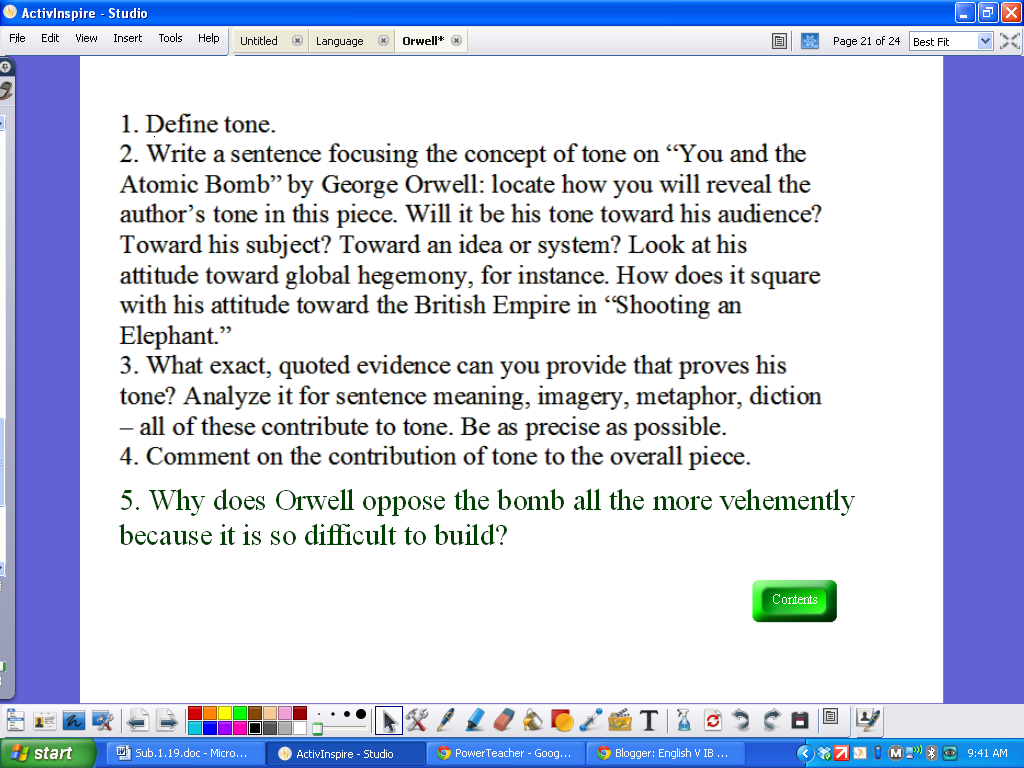
Finish up the writing piece after the walkabout. Read "Shooting an Elephant" by George Orwell. What statement does this piece make about empire? In what way, or how, does it make this statement? Do you recognize any symbols? (The symbol must have some consistency -- an elephant can't mean one thing here and another there).
Also, define these three terms in order to understand the differences among them: simile, metaphor, and analogy. Use the most appropriate terms as you discuss "Shooting an Elephant."
Plan on signing up for a time on January 19 to discuss your WLA 2. Have a tentative thesis (or hypothesis) and at least five quoted selections from which you intend to develop your hypothesis.
Also, define these three terms in order to understand the differences among them: simile, metaphor, and analogy. Use the most appropriate terms as you discuss "Shooting an Elephant."
Plan on signing up for a time on January 19 to discuss your WLA 2. Have a tentative thesis (or hypothesis) and at least five quoted selections from which you intend to develop your hypothesis.
Wednesday, January 11, 2012
Wednesday
On Thursday and Friday, we're taking a walk on the wild side. So wear good shoes and bring a coat. (It will be colder Friday than it is today, Thursday!)
Tuesday, January 3, 2012
Tuesday
Since Mr. Galeota is out tomorrow, the whole IB English class will meet in A221 for some prep time for each group before Friday. Bring whatever materials and ideas you think you might need!
Thursday, December 15, 2011
Thursday
Don't forget your question on "Preludes" under the Tuesday post. Also, note the "enduring product" portion of the assignment for January 6. That means a video, a whiteboard lesson, a powerpoint, a piece of student-created art, a set of screenshots -- something that will contribute to how we study for the Eliot chance on the oral commentary AND that will contribute to next year's students.
Wednesday, December 14, 2011
Wednesday
Prepare a lesson with your small group for January 6 that will teach us something new about Eliot's "Preludes."
Required:
Typed plan with
1. objective
2. plans to meet the objective: activities, handouts, shows, demonstrations
3. an enduring product to contribute to a legacy on this subject
4. a rational, thoughtful, specific, and fair rubric for me to assess you with
5. a way to assess the learning of the class
You have between 10 and 15 minutes. Otherwise, you are pretty free.
Required:
Typed plan with
1. objective
2. plans to meet the objective: activities, handouts, shows, demonstrations
3. an enduring product to contribute to a legacy on this subject
4. a rational, thoughtful, specific, and fair rubric for me to assess you with
5. a way to assess the learning of the class
You have between 10 and 15 minutes. Otherwise, you are pretty free.
Tuesday, December 13, 2011
Tuesday
B-day, read "Preludes" and post one question below. Ambitious A-day students can jump right in there as well, but you'll have to find the poem in the "EliotPack" to the right.
Friday, December 9, 2011
Friday
Find one snippet about Guy Fawkes that no one else is going to find and bring it in with you to the next class.
Thursday, December 8, 2011
Thursday
Read or re-read "Tradition and the Individual Talent." Read all of it, but focus your thinking during and after reading on paragraphs 9 and 17. How does Eliot challenge your thinking about art and poetry in these paragraphs? Can you explain what these paragraphs mean -- what is the emotional content of poetry, according to Eliot? How do these paragraphs affect how you read "Prufrock" or "The Hollow Men"?
As you know, the entire text of "Tradition and the Individual Talent" that we will discuss is embedded on the right side of this page.
As you know, the entire text of "Tradition and the Individual Talent" that we will discuss is embedded on the right side of this page.
Wednesday, December 7, 2011
Tuesday
For Thursday/Friday, revise and develop your commentary; type and format it. Keep up with all drafts and the feedback.
Wednesday, November 30, 2011
Wednesday
For Friday/Monday, again look at the first four paragraphs of "Tradition and the Individual Talent." Focus on paragraph 4 and write two honest interpretive questions about the material.
Write a commentary (by hand if you wish -- this is a draft) on the stanza from "The Journey of the Magi." Remember that every technique and method has a purpose. If you notice an allusion, first point it out and then explain (why Genesis and Revelation, why birth and death in the same poem?) its effect on the overall communication of the poem.
Write a commentary (by hand if you wish -- this is a draft) on the stanza from "The Journey of the Magi." Remember that every technique and method has a purpose. If you notice an allusion, first point it out and then explain (why Genesis and Revelation, why birth and death in the same poem?) its effect on the overall communication of the poem.
Monday, November 28, 2011
Monday
For Wednesday/Thursday, do two things:
1. Look at the little stanza about vegetation in "The Journey of the Magi" and mark every biblical allusion you recognize. Look up (in a Bible of your own or online, perhaps at Biblegateway.com) any word or image that you THINK might be an allusion. Write your findings in the margins of a copy of the poem.
2. Read the first three paragraphs of Eliot's "Tradition and the Individual Talent." Focus on the third paragraph and write out three clear, honest questions about it.
You can follow the above links for Google doc versions of each piece, or you can download "Eliotpack" from the right. It has all of these pieces in it.
1. Look at the little stanza about vegetation in "The Journey of the Magi" and mark every biblical allusion you recognize. Look up (in a Bible of your own or online, perhaps at Biblegateway.com) any word or image that you THINK might be an allusion. Write your findings in the margins of a copy of the poem.
2. Read the first three paragraphs of Eliot's "Tradition and the Individual Talent." Focus on the third paragraph and write out three clear, honest questions about it.
You can follow the above links for Google doc versions of each piece, or you can download "Eliotpack" from the right. It has all of these pieces in it.
Monday, November 14, 2011
Monday
II have made the preparation document public (it was not before). You should be able to open it or download it now.
Thursday, November 10, 2011
Thursday
Two new documents are embedded to the right of the page: a rubric for the dramatic interpretation of "Prufrock" and a planning guide that you should look at and complete after giving some thought to what you are going to do.
Check again later. I'm getting some ideas up here in Beantown.
Check again later. I'm getting some ideas up here in Beantown.
Wednesday, November 2, 2011
Wednesday
After viewing the assassination of Duncan, write about a page for sharing in class (not a PAPER, but a written response) on one of the following ideas. Think of how the movie's choices communicate something from the play:
- hands, as highlighted in the scenes immediately after the assassination
- Lady Macbeth's faint
- the role of Macduff as he knocks and as he enters and exits Duncan's chamber...you may consider H of D as you respond
Thursday, October 27, 2011
Thursday
I thought we had some very strong performances today. Congratulations and thanks.
The written commentaries are looking a little thin, however. To start, ask yourself, 'What is the author doing with this scene? What is its purpose, and how does the author accomplish that purpose?" The characters are simply tools and have no importance in and of themselves: they communicate something. What is the author communicating, and why this way in this particular extract?
Then, recognize the sentence as the basic unit of logic. Each one must make sense and transition logically (in time, space, and meaning) to the next. Finally, use these sentences to construct one paragraph at a time. Write good paragraphs. That's important. It's not about dashing off sacred genius thoughts. It's about figuring out a tough problem and explaining it to someone else.
Then look at this model for body paragraphs:
Hypothesis (or topic sentence; it should include a word suggestive of WHY the author chose the methods he did).
Evidence from the text (quotes or very close references)
Analysis of component parts of the quoted text (break it apart and look at how each piece functions to do the WHY of the hypothesis. You are looking at sentence and paragraph structure; word choice (diction); figures of speech; temporal and spatial arrangements and changes; punctuation; ANYTHING that signifies.
Evaluation of the analysis and connection to what has come before. No randomizing here; every piece contributes to some overall effect (theme, character, mood, tone (try looking up the difference between tone and mood if you insist on not listening)). All the analyzed parts work to communicate something. What? Answer, on the paragraph level, SO WHAT?
Now look back. I called the first sentence a hypothesis. Does your evidence support it? If not, go back and modify it. You are not ramming a thesis through the text, or cramming evidence into the Procrustean bed of a thesis, but you are testing your way through the text to find out what hypothesis the evidence can support. Then double check to make sure you make sense, sentence by sentence from beginning of the paragraph to the end.
Conclude the multiparagraph commentary by making meaning of the entire extract and how it fits within the whole work. Connect up as many loose ends as you can. If you are deliberate and logical, and don't hurry just to dash something down, you will enlighten yourself through this process. Plus, your paper and your score will be MUCH BETTER!
You have to work to get anything. If you don't do something, nothing will happen.
Friday, October 21, 2011
Friday
Since the college day will interfere with individual performances for A-day on Wednesday, those performances are rescheduled for Monday, as they were originally.
Have fun at the ball game...GO STALLIONS!
(Just kiddin'.) (Not about the Stallions).
Wednesday, October 19, 2011
Monday, October 17, 2011
Monday
See the individual rubric to the right. Note that performance and commentary have equal weight. See the descriptors as you prepare. I will apply it as it is written. If you spot problems or have suggestions, post as a comment or email me.
October 20-21: individual parts
October 24-25: group skits
The group rubric is also to the right. It is beneath the individual rubric and is far more simple.
Monday, October 10, 2011
Monday
Discussions led us to declare due dates of October 20-21 for the memory pieces and October 24-25 for the skits.
The calendar has been updated.
The calendar has been updated.
Wednesday, October 5, 2011
Wednesday, Part Deux
Are you remembering the blog assignment?
See below (Wednesday) for the next big assignment. Meanwhile, look at the following responses and vote on the right for the one you think is the best IB answer. We'll discuss your responses in class.
A. There are two pictures, one of Willert and one of a stone idol. It is a much darker image than at the beginning of the movie, which has fire in the background. There is a sound over it all: "The horror. The horror." The idea has changed completely from when all Willert wanted was a mission.
B. The image communicates the transition of power from Kurtz to Willert through Willert's killing Kurtz. It also shows the harsh effects of the river and the jungle and how they change the personalities of Willert and the other soldiers. It shows how Willert has changed, but also how he leaves and does not want to stay in the jungle and assume the role of a new Kurtz when he knew it was possible. It is obvious that, though he sides with Kurtz over the army, he does not want to stay and become Kurtz.
C. The visual shows how the war went from the soldiers all the way to the native culture and that it affected all and how they could never truly be meshed together.
D. It looks as if Willert has become Kurtz, and they also show a stone idol which strengthens Willert's tranformation into Kurtz because Kurtz was an idol to his people. Also, compared to the opening credits, Willert has face paint on and knows the effect of his journey on him.
See below (Wednesday) for the next big assignment. Meanwhile, look at the following responses and vote on the right for the one you think is the best IB answer. We'll discuss your responses in class.
A. There are two pictures, one of Willert and one of a stone idol. It is a much darker image than at the beginning of the movie, which has fire in the background. There is a sound over it all: "The horror. The horror." The idea has changed completely from when all Willert wanted was a mission.
B. The image communicates the transition of power from Kurtz to Willert through Willert's killing Kurtz. It also shows the harsh effects of the river and the jungle and how they change the personalities of Willert and the other soldiers. It shows how Willert has changed, but also how he leaves and does not want to stay in the jungle and assume the role of a new Kurtz when he knew it was possible. It is obvious that, though he sides with Kurtz over the army, he does not want to stay and become Kurtz.
C. The visual shows how the war went from the soldiers all the way to the native culture and that it affected all and how they could never truly be meshed together.
D. It looks as if Willert has become Kurtz, and they also show a stone idol which strengthens Willert's tranformation into Kurtz because Kurtz was an idol to his people. Also, compared to the opening credits, Willert has face paint on and knows the effect of his journey on him.
Wednesday
As assigned in class:
- Students must, as singles or as pairs, choose from Macbeth a monologue of at least 20 lines for singles or 40 lines for pairs to memorize. Each group (or individual) should choose from Act 1, 2, 3, 4, or 5 in sequence until every act is covered by at least one group. Performance groups are not to let their scenes overlap, and the beginning, middle, and end of the play should be represented.
- When the speech is memorized, it is to be performed in front of the class. The performance should include
- An intro that contextualizes the speech and explains its importance to the meaning of the play as a whole.
- A fluid demonstration of memorized lines.
- A review, after the main performance, of the scene in a line-by-line fashion that thoroughly investigates every image and figure of speech, connecting them to meaning. The speaker should re-recite two or three lines, and then stop to explain them thoroughly, so that a fifth grade CP student could understand it AND so that a scholar could recognize the speaker’s insight. That is, be critically astute but plain-spoken in explanation.
- A written commentary on the same scene to be turned in on the day of the performance.
- The tentative date for performance is October 12 and 13. I will further discuss this date with you if there are known conflicts.
- Also, form larger groups of four and ADAPT a complete scene from the play – the way Apocalypse Now adapts Heart of Darkness. Use new language to suit a new time and place. The adaptation should emphasize at least one motif from the original play. Actors may hold a script – it does not have to be memorized. This scene should be about ten minutes in length, and the actors should be ready for an interview about their choices after the performance. The tentative due date for this performance is October 18 and 19.
If you have questions, post them as comments here and I will answer in another comment.
Monday, October 3, 2011
Monday
Write one or two fully developed paragraphs in response to one of the following prompts. Post your responses as comments below this post. Interact with each other's thoughts. The deadline is class time Wednesday/Thursday.

Friday, September 30, 2011
Friday
Review the handout and try to be familiar with the speeches mentioned. I will not hold you to any written responses because the page numbers are incorrect. I think they must be from the previous edition of the textbook). Apologies.
Wednesday, September 28, 2011
Wednesday
Finish the Act III guide and prepare for reading discussions or quizzes next class period. B-day has the guide; A-day gets it Thursday.
Tuesday, September 27, 2011
Wednesday, September 21, 2011
Wednesday
With B-day, we'll hear Act I homework information and begin the movie if we get that one missing permission in. If not, we will have a reading quiz and begin another assignment on Acts 2 and 3.
Keep reading Macbeth -- finish the play by Tuesday/Wednesday.
Keep reading Macbeth -- finish the play by Tuesday/Wednesday.
Monday, September 19, 2011
Thursday, September 15, 2011
Thursday
Group 1 assignment: Read Act I.1.1-11 and I.3.1-75. From these lines, draw inferences about what powers the witches possess. Also, what are the limits of their powers? How, exactly, from these lines, do you know?
Group 2 assignment: Read Act I.2.1-55. Mark and explain images of equivocation or of things being in precarious balance. Then focus tightly on lines 25-34 as the Bloody Captain (or Sergeant) speaks. Explain, line by line and word by word, what this passage means and what it implies about the play and about Macbeth.
Group 3 assignment: Read Act I.3.38-152. Contrast Banquo's reactions to the witches with Macbeth's reactions. Focus tightly on lines 120-142, Macbeth's soliloquy. Explain, line by line and word by word, what this passage means and what it implies about the character of Macbeth.
Tuesday, September 13, 2011
Tuesday
For Thursday/Friday, bring in your permission forms and read Act I of Macbeth and Plato's "The Allegory of the Cave."
Monday, September 12, 2011
Monday
Remember the files of the WLA 1 paper! See naming protocol below.
John and Grant: something is awry. No email from you!
John and Grant: something is awry. No email from you!
Wednesday, September 7, 2011
Wednesday
Written commentaries Friday and Monday...Prepare!
WLA 1 due with the peer feedback Tuesday/Wednesday with a revised version given to me electronically. Naming protocal:
Lastname.first.WLA1.doc
Thursday, September 1, 2011
Thursday
I uploaded a new passage for discussion. It is on the right side of the blog and is labelled "9.1 Passage for comment." B-day should respond by Sunday midnight (Sept. 4) and A-day by Monday midnight (Sept. 5). Grant volunteered to start us today, so you can work anytime between today and the deadline.
1. Engage the previous entries in the discussion thread: be specific in your reference to it.
2. Use one or more of the following critical terms correctly in your comments: narrator, digression, allegory, ambiguity, connotation, diction, irony, metaphor, paradox, satire, or tone. You may also use others of your own choosing (Of course!). Look these terms up and make efforts to understand them.
3. Write one interpretive question (one that requires us to look at the text itself and create an interpretation of its meaning) to prompt future thoughts on the passage.
4. Develop your thoughts clearly. You are not required to apply your critics. You MAY do that, but focus tightly on the passage provided. Quote from and interpret its style, on the ways Conrad creates his effects and complicates or clarifies meanings. Try to get the passage all over your hands in this response. Do not try to sound pretty. Be clear. At the same time, do not be afraid to experiment with your thinking. Clear language HELPS you to lead you to new thinking -- it really does...I promise.
I would write in Word and then copy it to the blog to keep from losing big blocks of material when the internet flickers. Comment here under Thursday's post.
1. Engage the previous entries in the discussion thread: be specific in your reference to it.
2. Use one or more of the following critical terms correctly in your comments: narrator, digression, allegory, ambiguity, connotation, diction, irony, metaphor, paradox, satire, or tone. You may also use others of your own choosing (Of course!). Look these terms up and make efforts to understand them.
3. Write one interpretive question (one that requires us to look at the text itself and create an interpretation of its meaning) to prompt future thoughts on the passage.
4. Develop your thoughts clearly. You are not required to apply your critics. You MAY do that, but focus tightly on the passage provided. Quote from and interpret its style, on the ways Conrad creates his effects and complicates or clarifies meanings. Try to get the passage all over your hands in this response. Do not try to sound pretty. Be clear. At the same time, do not be afraid to experiment with your thinking. Clear language HELPS you to lead you to new thinking -- it really does...I promise.
I would write in Word and then copy it to the blog to keep from losing big blocks of material when the internet flickers. Comment here under Thursday's post.
Tuesday, August 30, 2011
Tuesday
The future holds this: see the calendar. In addition to the critical essays you present, read both Watt (349) and Brantlinger (386). Focus like a laser on what they have to say about Conrad's style. If one of these critics is your assignment for presentation already, read the other one and at least one more criticism.
I am grading blog posts strictly on fulfillment of requirements with a bonus for really thoughtful entries. I am grading the discussions on fulfillment of requirements. Be clear and focused about your three main points. I will not grade your written commentary until you convince me you have read the novel, and you better hurry up and do that. I'm here before and after school, you know. I will then assess the commentaries with the IB commentary rubric available from the IB Handbook posted to the right.
Keep an eye on your WLA 1 revision!
These scheduled events develop your grade on Heart of Darkness and complete the progress report period.
I am grading blog posts strictly on fulfillment of requirements with a bonus for really thoughtful entries. I am grading the discussions on fulfillment of requirements. Be clear and focused about your three main points. I will not grade your written commentary until you convince me you have read the novel, and you better hurry up and do that. I'm here before and after school, you know. I will then assess the commentaries with the IB commentary rubric available from the IB Handbook posted to the right.
Keep an eye on your WLA 1 revision!
These scheduled events develop your grade on Heart of Darkness and complete the progress report period.
Monday, August 29, 2011
Monday
CORRECTION: WLA 1 is due, file and paper, on Tueday/Wednesday, September 13/14. Sept. 13 is an A day.
Thursday, August 25, 2011
Thursday
Reminder: As you bring in your WLA 1 files, be sure they are saved as something compatible with MS Word 2003. Use the drop down "save as type" box and click .doc or .rtf. Documents saved as .docx and .xml do not look right when opened with school computers. WLA 1 revisions will be due September 14.
Now, the assignments for Monday/Tuesday:
A. Read your selected criticism. Note its three main points and compose five good questions on a selection of your choosing from Heart of Darkness that will help others see those main critical points. Confer with your partners about the selection and questions; talk over the implications of the critic's essay. Present your points and lead a short discussion of your selection Monday/Tuesday.
B. Read the passage posted to the right and dated 8.25. Then read all comments from your classmates in this thread. Post here, as "comments" on this assignment posting (Thursday, August 25), a commentary on it. Include a reference to the student who has posted just before you (extend or argue one of her points); an interpretive question on the passage (perhaps based in your critical reading) that will prompt thoughts from your classmates; and an application of some idea from your critic (be sure to acknowledge the critic by name). Develop your thoughts clearly. You may consider speaker, tone, imagery, diction, figures of speech, style, structure, and progression of ideas in the passage. I would write in Word and then copy it to the blog to keep from losing big blocks of material when the internet flickers. Everyone should have an entry posted by Saturday midnight for A-day and Sunday midnight for B-day, or you will be charged a late fee. Think hard and write clearly.
Wednesday, August 24, 2011
Wednesday
See Tuesday's post for your assignment. Check Parent Portal to see your grade if think you might need to retake the Part 3 quiz.
Tuesday, August 23, 2011
Tuesday
Bring in your WLA 1 files to work on in class. If you want a retake for H of D reading quiz one, two, or three, come prepared Thursday/Friday.
Monday, August 22, 2011
Wednesday, August 17, 2011
Wednesday
Read Part II. Firm up your choices about WLA 2: rank three sets of options in case the first choice is not available.
Monday, August 15, 2011
Monday
For Wednesday (A)/Thursday (B), read Part I of Heart of Darkness by Joseph Conrad. Bring in your WLA 1 as a file and as a paper copy for revision. Bring your handout "The Social Me" by William James. Begin thinking about the works on which you would like to base your WLA 2.
Tuesday, April 12, 2011
Tuesday
Remember that the explication is to be a full attempt. It should be finished and formatted and documented. If it is not complete on time, you lose 20%. If it is not finished in one week (excepting the break, of course) you get no credit, which in these strange times means you make a 40. Still, you must HAVE a second draft with my feedback before turning in the THIRD draft. So you can't get around it. Be sure to show that you addressed my previous comments from the first draft, and turn in the old draft with the new one (so I can check that you have addressed my comments without having to dig up the comments on my computer).
Too many drafts are coming in partial or oddly formatted. Use MLA style. You might have to rearrange some DISCUS citations to fit MLA. I don't know what style they are using that puts the title first, but we use MLA.
Tuesday, March 22, 2011
Wednesday
Sometimes, you know, with advanced students, I just make assumptions. When you write your slightly researched explications, do not google up any random dude in cyberspace and quote him as if he knows something.
Command one: If you do not go to the library and use some of the critical resources there, go to DISCUS and look for your poem on "Literature Resources from Gale." These sources are valid. Nameless goobers from the internet are NOT valid sources. Stop resisting doing things right.
Command two: Create, right now, your works cited page. Create it the right way. DO NOT copy up some urls and paste them into your paper as if that constitutes citing a source. If your internet source has no author, editor, or sponsoring organization, it is NOT a valid source. Try DISCUS. It doesn't hurt at all. Use MLA style. Don't know what that is? FIND OUT! It's easy. Try the OWL at Purdue.
Command three: Make unmistakably clear which thoughts in your explication are yours and which are from a published critic. Unmistakably clear.
Have you not done research and used reliable, valid resources before? COME ON HERE!
See Megan B. if you need to know how to do an in-text citation and use a critic properly. See Elicia if you want to know, just flat out, how this is done, top to bottom, with works cited.
Command one: If you do not go to the library and use some of the critical resources there, go to DISCUS and look for your poem on "Literature Resources from Gale." These sources are valid. Nameless goobers from the internet are NOT valid sources. Stop resisting doing things right.
Command two: Create, right now, your works cited page. Create it the right way. DO NOT copy up some urls and paste them into your paper as if that constitutes citing a source. If your internet source has no author, editor, or sponsoring organization, it is NOT a valid source. Try DISCUS. It doesn't hurt at all. Use MLA style. Don't know what that is? FIND OUT! It's easy. Try the OWL at Purdue.
Command three: Make unmistakably clear which thoughts in your explication are yours and which are from a published critic. Unmistakably clear.
Have you not done research and used reliable, valid resources before? COME ON HERE!
See Megan B. if you need to know how to do an in-text citation and use a critic properly. See Elicia if you want to know, just flat out, how this is done, top to bottom, with works cited.
Tuesday, March 8, 2011
Tuesday
Check calendar and receive assignments for last nine weeks. This nine weeks will conclude on March 22 and will contain the revision of the Orwell pieces and the "Coy Mistress" group commentary.
Friday, March 4, 2011
Monday, February 28, 2011
Friday, February 18, 2011
Friday
I will see all of you for Monday's trial oral commentary.
Your WLA 2 is due on February 28, electronically in WebLocker and hard copy to me. Format exactly as last year's WLA 1. Have access to your files EVERY CLASS DAY between now and February 28.
The real oral commentaries will be March 2 and 3. Watch for schedule posting on my door.
From there, I will begin working with you with the material for the final IB exams.
Your WLA 2 is due on February 28, electronically in WebLocker and hard copy to me. Format exactly as last year's WLA 1. Have access to your files EVERY CLASS DAY between now and February 28.
The real oral commentaries will be March 2 and 3. Watch for schedule posting on my door.
From there, I will begin working with you with the material for the final IB exams.
Wednesday, February 9, 2011
Wednesday
B-day, please refresh your reading of "Down the Mine." We will discuss it in class Thursday based on YOUR five interpretive questions.
Also, remember the five common traits of Orwell's essays that you are to discern from "The Spike" and all previous essays.
You will receive "Shooting an Elephant" and the remaining essays Thursday.
Also, remember the five common traits of Orwell's essays that you are to discern from "The Spike" and all previous essays.
You will receive "Shooting an Elephant" and the remaining essays Thursday.
Monday, February 7, 2011
Monday/Tuesday
Read "The Spike" and figure out five literary features that are common to all the Orwell essays. List them on paper and mark up a section on that basis. We may also return to "Down the Mine."
Tuesday, February 1, 2011
Tuesday
WLA 2 drafts for B-day Wednesday. Bring walking shoes and coats to class Thursday/Friday. We'll go on a little expedition. Also, keep WLA 2 materials handy at all times so that you can work on the big kahuna whenever there is a spare moment and a rack of computers.
Wednesday, January 26, 2011
Monday, January 24, 2011
Monday
For Wednesday/Thursday, read George Orwell's "A Hanging" and choose a short passage to parse. Present in class.
Thursday, January 20, 2011
Thursday/Friday
For Monday/Tuesday's assignment, use "Lastname.Hollow.doc" as file naming protocol. Put papers in "Hollow Men" folder in Web Locker. Exactly one double-spaced page with no header (your name is in filename). If you cite the critic, simply use his name: "As Grover Smith suggests, the poem has a great deal of convergence with Heart of Darkness." In this case, do not make a Works Cited page. We all have the critical essays.
Tuesday, January 18, 2011
Tuesday
Click here to go to School Web Locker, where you can store your documents for the rest of the year. It is like Dropbox but I can access it, so it is a good place to put schoolwork. You can access it from anywhere through the internet. It does not have that great desktop folder like Dropbox, but you can see its usefulness.
Turn in your paper FINAL final WLA 1 at the start of your next English class period. Place your electronic file of FINAL final WLA 1 in Dropbox by midnight on the due date.
Turn in your paper FINAL final WLA 1 at the start of your next English class period. Place your electronic file of FINAL final WLA 1 in Dropbox by midnight on the due date.
Monday, January 17, 2011
Monday
Looking at calendars makes me want to vomit, so what can I say when the schedule gets changed on me? B day class, have your final final on Wednesday. A day, have your final final on Wednesday also.
Thursday, January 13, 2011
Thursday
For Monday, bring in any revisions you have made on WLA 1. It is due on Tuesday/Wednesday in its final final form. Also for Tuesday/Wednesday, read the Eliot essays and report on them and how they relate or explain "The Hollow Men."
Friday, January 7, 2011
Friday
Bring a file copy of your WLA 1 to class on Monday and Tuesday. We will work on them during class, and I will show you a couple of ways to make use of Word to proofread.
Monday, January 3, 2011
Monday
Bring in WLA 2 plans on Wednesday/Thursday. You will receive a handout to help with this. Be prepared to discuss and defend your ideas.
Friday, December 10, 2010
Friday
Performances will be on Wednesday for everyone.
Friday class, bring data file of your WLA 1 to revise in class and a thesis idea for WLA 2.
Thursday, December 2, 2010
Thursday
For next class, be assured I will give at least 45 minutes from the beginning of class to the Prufrock preparations. If you can, begin reading or rereading your world lit material and cogitate over some good topics. Everyone may proceed with the first choice.
I have asked for the entire group for performance day so that everyone can see the work of the others.
I have asked for the entire group for performance day so that everyone can see the work of the others.
Wednesday, December 1, 2010
Wednesday
All those who chose One Hundred Years of Solitude (4) or The House of the Spirits (1) as their first choice may proceed.
Monday, November 29, 2010
Tuesday/Wednesday
1. Make a list of your top three choices of world lit books for WLA 2.
2. Reread "The Love Song of J. Alfred Prufrock." You will need to be informed about your group's decisions about how the poem is divided up.
3. Write your three interpretive questions from your assigned section of "Tradition and the Individual Talent."
4. Think and work on revising your WLA 1 (no grade or checkup on this).
I will take your choices and try to get books into your hands as quickly as possible. Then we will discuss "Tradition." For the last 20 minutes, we will work in groups for "Prufrock."
Also, take note of the deadline. If there is a problem, speak to it NOW!
Wednesday, November 17, 2010
Wednesday
Complete feedback for WLA 1. Read "Tradition and the Individual Talent." Consider performance possibilities.
Tuesday, November 16, 2010
Tuesday
Have a happy late start day. Here is the link to the website for Andrew Allen.
I recommend Flight, The Thomas Beale Cipher, and The Emperor of Ice Cream. Most of the rest is commercial in nature.
Read "Tradition and the Individual Talent" for Thursday/Friday. Those who have not finished feedback, finish that up.
I recommend Flight, The Thomas Beale Cipher, and The Emperor of Ice Cream. Most of the rest is commercial in nature.
Read "Tradition and the Individual Talent" for Thursday/Friday. Those who have not finished feedback, finish that up.
Friday, November 5, 2010
Friday
Oral commentaries are Monday and Tuesday, following a long IB tradition of moving back deadlines and running out of time. When I first moved the deadlines on the calendar (and I can hardly stand to look at a calendar), I did not consider election day. Sorry for the nerves.
Subscribe to:
Posts (Atom)